Finding the right driver length can transform your golf game. It impacts your stance, posture, and ability to hit the clubface consistently. Most golfers unknowingly use clubs that don’t fit them, leading to missed shots and awkward swings. Here’s what you need to know:
- Driver length matters: A longer shaft may give you more speed but is harder to control. A shorter one improves accuracy and consistency.
- Standard isn’t universal: Men’s drivers typically range from 45.0″–45.75″, while women’s are shorter. Your height and arm length often require custom adjustments.
- Tour pros go shorter: PGA players average 44.5″, prioritizing control over maximum distance.
- Find your fit: Measure wrist-to-floor distance, experiment with different lengths, and test for center-face contact.
- Adjustments affect feel: Shortening a driver makes the clubhead feel lighter, which may require adding weight for balance.
If your shots feel inconsistent or off-center, tweaking your driver length could be the solution. Proper fitting can lead to better distance, accuracy, and scoring. Read on for tips to measure, test, and adjust your driver for peak performance.
Choosing the Correct Driver Shaft Length | Golf Club Fitting Discussion
Standard vs Optimal Driver Lengths
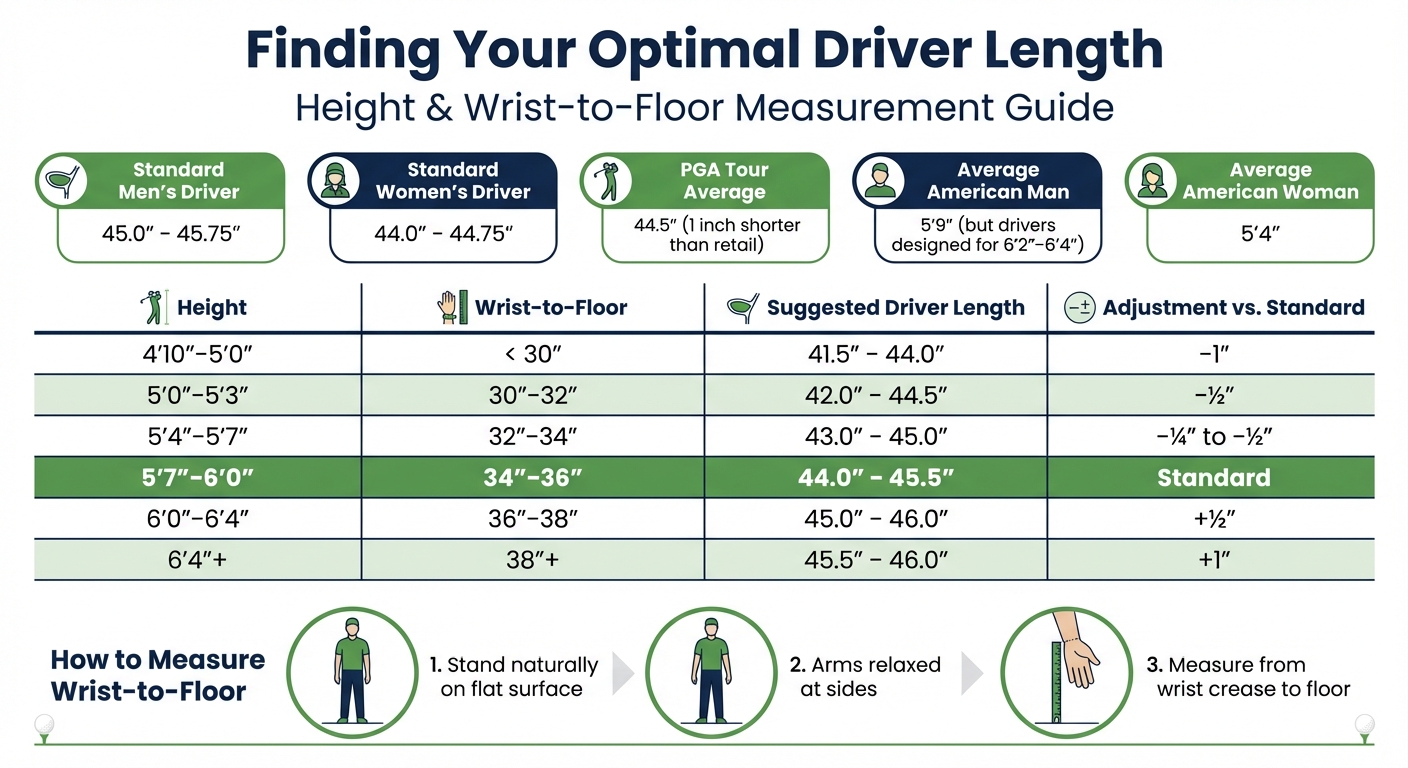
Driver Length Guide by Height and Wrist-to-Floor Measurement
Standard Driver Lengths for Men and Women
In the U.S., men’s drivers typically measure around 45.5 inches in length. The standard range generally falls between 45.0 and 45.75 inches, with many manufacturers leaning toward the longer end of this spectrum. For women, drivers are shorter, usually ranging from 44.0 to 44.75 inches.
However, these “standard” lengths often don’t match the average golfer’s height. For instance, the average American man is 5’9″, yet most drivers are designed for someone 5–7 inches taller. Similarly, the average American woman is 5’4″, while women’s stock drivers are about 44 inches long. Manufacturers tend to prioritize longer shafts to increase clubhead speed, even though this may not suit every golfer’s build or swing.
| Height | Wrist-to-Floor | Suggested Driver Length | Adjustment vs. Standard |
|---|---|---|---|
| 4’10″–5’0″ | < 30" | 41.5″ – 44.0″ | –1″ |
| 5’0″–5’3″ | 30″–32″ | 42.0″ – 44.5″ | –½” |
| 5’4″–5’7″ | 32″–34″ | 43.0″ – 45.0″ | –¼” to –½” |
| 5’7″–6’0″ | 34″–36″ | 44.0″ – 45.5″ | Standard |
| 6’0″–6’4″ | 36″–38″ | 45.0″ – 46.0″ | +½” |
| 6’4″+ | 38″+ | 45.5″ – 46.0″ | +1″ |
For a more tailored fit, professional systems use a wrist-to-floor (WTF) measurement to determine the ideal driver length. To measure this, stand naturally on a flat surface with your arms relaxed at your sides, and have someone measure from the crease of your wrist to the floor. This method considers arm length and posture, offering a more precise fit than height alone.
These general guidelines are just the starting point. Next, let’s see how professional golfers approach driver length.
How Tour Pros Choose Their Driver Length
When it comes to driver length, professional golfers follow a different playbook. On the PGA Tour, the average driver length is 44.5 inches – about an inch shorter than the typical retail driver. Although the USGA allows shafts up to 48 inches, most pros favor consistent center-face contact over maximum shaft length, as off-center strikes can cancel out any speed gains.
Tour players rely on tools like launch monitors and impact tape or spray to fine-tune their driver length. This helps them strike the perfect balance between clubhead speed and consistently hitting the sweet spot. GOLF Top 100 Teacher Kevin Sprecher critiques the industry’s approach:
“Most manufacturers have lengthened their standard driver from 45 inches to 45.5 or 45.75, because a longer shaft typically results in more club speed… However, in many cases the opposite happens, because longer shafts make it more difficult to hit the center of the club face”.
Even among tour-level equipment, there’s variation. For example, the Ping G410 Plus and TaylorMade M5/M6 drivers measure 45.75 inches, while the Callaway EPIC Flash and Titleist TS2/TS3 come in slightly shorter at 45.5 inches. Interestingly, the Cobra F9 Tour Length is offered at 44.5 inches – closer to what many pros actually use.
These insights from the pros highlight the importance of customizing your driver length for better performance.
Finding Your Optimal Length
Your ideal driver length isn’t just about height – it also depends on factors like swing speed, posture, and playing style. If your shots tend to hit the heel or toe of the club, adjusting the length can help you find the sweet spot and maintain distance.
To discover your perfect fit, test drivers ranging from 44 to 47 inches using impact tape or face spray. This will help you identify the length that produces the most consistent center-face contact. According to Kevin Sprecher, some golfers gain an extra 10–20 yards simply by switching to a driver that improves their accuracy. A shorter club doesn’t necessarily mean sacrificing distance.
However, shortening a driver can change its feel. Removing even one inch can make the clubhead feel noticeably lighter. To counteract this, consider adding weight to the clubhead or opting for a slightly heavier shaft – about 10 grams heavier – to maintain the right swingweight and balance. This is where professional club fitting becomes essential, ensuring that any adjustments enhance rather than hinder your game.
Factors That Influence Driver Length Selection
Swing Speed and Tempo
Your swing speed and tempo are crucial in deciding whether a longer or shorter driver suits your game. A longer shaft can increase clubhead speed and add about 4 yards of carry – but only if you’re consistently hitting the center of the clubface.
Your swing style matters more than just speed. Golfers with smooth, rhythmic swings often see little to no distance improvement with a longer driver because they don’t generate enough angular speed to take advantage of the extra length. On the other hand, players with aggressive swings and faster transitions tend to gain yardage from a longer club. However, there’s a trade-off: as the shaft gets longer, accuracy tends to suffer. Standing farther from the ball increases the difficulty of controlling your swing arc. Erik Henrikson, Innovation and Fitting Science Manager at PING, sums it up well:
“As a general rule, an increase in length can increase distance, but will usually lead to a significant decrease in accuracy”.
If you’re unsure about your contact consistency, use impact tape to check if you’re striking the center of the face. If launch monitor data doesn’t show meaningful yardage gains with a longer driver, you’re better off sticking with a shorter, more controllable option.
Beyond swing dynamics, your body measurements and posture also play a big role in determining the right driver length.
Body Measurements and Posture
While standard driver lengths provide a starting point, your body measurements ultimately determine the best custom fit. Height is important, but arm length often has an even bigger impact. For instance, two golfers who are both 6 feet tall might need different driver lengths if one has longer arms than the other. Your arm length and posture directly influence how comfortably you can address the ball.
Golfers with longer arms relative to their height generally need shorter drivers to maintain proper posture. Conversely, shorter arms may require a longer driver to avoid excessive hunching. A club that’s too short forces you to bend too much, while one that’s too long makes you stand too upright – both of which can hurt your consistency and power. The goal is to find a length that allows you to stand naturally, with a slight hip bend and relaxed arms hanging freely.
After considering swing speed and body mechanics, it’s also important to understand how changing driver length affects the swingweight and overall feel of the club.

Impact on Swingweight and Feel
Adjusting your driver’s length doesn’t just change how far you stand from the ball – it also alters the club’s feel during your swing. Swingweight measures how “head-heavy” or “light” a club feels in your hands, which is different from its total weight. Shortening a driver by half an inch lowers its swingweight by about 3 points, a difference most golfers notice immediately.
A shorter driver shifts the balance point closer to your hands, making the clubhead feel lighter – sometimes too light, which can lead to pulling your shots. On the flip side, a longer driver feels more head-heavy, which might cause you to push shots. Jeff Summitt, a clubmaking expert at Hireko Golf, explains:
“By cutting the driver down in length, it does change the heft, or how head-heavy the club feels in your hands. In essence, you have effectively reduced the swingweight”.
To maintain the original feel when shortening a driver by half an inch, you’ll need to add about 5 grams to the clubhead. This adjustment is typically done using lead tape or adjustable weight screws. Most men’s drivers fall into the D0 to D3 swingweight range, while women’s drivers usually range from C6 to C9. Before committing to a permanent change, try choking down on the grip to simulate a shorter length and see how it impacts your ball flight and overall feel.
Fine-tuning the swingweight is a crucial final step in achieving the perfect driver fit.
Step-by-Step Guide to Customizing Driver Length
Measuring Your Starting Point
Before making any changes, it’s crucial to figure out your current driver length. The standard way to measure involves placing the club in its natural address position, ensuring the sole is flat on the ground. Then, using a rigid ruler, measure along the back of the shaft from the heel to the grip cap. Keep in mind that most manufacturers measure up to the edge of the grip cap, not the raised “bubble” in the center.
You can double-check this measurement against your wrist-to-floor (WTF) measurement. Static fitting charts can offer a good starting point, but they’re just that – a starting point. For example, a golfer between 5’10″ and 6’0″ with a WTF of 35.25″ to 40.25″ might begin with a 44.5″ driver. Meanwhile, someone taller, around 6’0″ to 6’2″, with a WTF of 36.50″ to 41.25″, would typically start with a 45.0″ driver.
Testing Different Lengths
Once you’ve established your baseline, it’s time to see how different lengths work with your swing. To experiment without committing to a permanent change, try choking down 1 to 1.5 inches on the range. This simple adjustment can help you evaluate how a shorter length impacts your control and consistency.
Use tools like impact tape or a marker to monitor where the ball strikes the clubface. If you notice consistent toe hits, the shaft might be too short. On the other hand, frequent heel hits could mean the shaft is too long. The goal is to find a length that complements your swing and allows for consistent, center-face contact. As Spencer Lanoue, Founder of Caddie AI, points out:
“A center-face strike with a slightly shorter shaft is overwhelmingly more efficient than an off-center hit with a longer one. Hitting the middle of the face is the true king of distance”.
If you have access to a launch monitor, focus on metrics like ball speed and shot groupings rather than just achieving a single long drive. Erik Henrikson from PING highlights the importance of consistency:
“Evaluate the best shots with the different drivers you try, but analyzing the grouping of shots with each is crucial to assessing the true performance of a configured driver”.
Golfers who go through a proper driver fitting often see impressive results. On average, they gain 11 yards in total distance, 9.5 yards in carry distance, and reduce their shot dispersion area by 25%. Once you’ve nailed down the right length, it’s time to adjust the swingweight to keep the club balanced.
Adjusting for Swingweight
After finding your ideal shaft length, the next step is to adjust the swingweight to maintain the club’s balance and feel. Changing a driver’s length directly impacts swingweight. Shortening the shaft makes the clubhead feel lighter, while lengthening it makes the head feel heavier. To counteract this, adjust the swingweight by adding or removing weight – typically 2 grams for every half-inch change in length.
For example, if you cut your driver down by half an inch, you’ll need to add weight to the clubhead to restore the original feel. Drivers with adjustable weights make this process straightforward. But if your driver doesn’t have this feature, applying lead tape to the clubhead is a simple and effective alternative.
Where you place the added weight also matters. Adding weight closer to the face reduces spin and lowers launch, while placing it toward the back increases launch and stability. Additionally, positioning weight in the heel can help correct a slice, while placing it near the toe can reduce a hook. These small tweaks ensure your driver feels just right and performs at its best.
sbb-itb-bcd8bdd
Cutting Down or Extending a Shaft
Making permanent changes to your driver shaft requires both the right tools and careful handling. You’ll need a sturdy workbench, a bench vise, and a rubber clamp to secure the shaft firmly without damaging it – this is especially important for graphite shafts, which are more delicate. For precision, use a rigid 48-inch ruler and mark the cutting point with a permanent marker.
The cutting tool you use depends on the shaft material. For steel shafts, a rotary tool with a metal cutting wheel works best. For graphite, a fine-toothed blade is ideal, but wrapping the marked area with tape before cutting can help prevent fraying. After cutting, smooth the edges with 220-grit sandpaper and a metal file. You’ll also need re-gripping supplies, such as a hook blade utility knife, double-sided grip tape, and a solvent like mineral spirits or a specialized grip solvent to reapply the grip. Always wear safety glasses and gloves, as cutting shafts – especially graphite – can produce hazardous dust.
Keep in mind that cutting a driver shaft by 0.5 inches typically reduces the swingweight by about 3 points. To restore the original feel, you can add approximately 6 grams of lead tape. These small but precise adjustments are essential for maintaining the driver’s balance and ensuring optimal swing performance.
Using Adjustable Drivers
If you’re hesitant to make permanent changes, adjustable drivers offer a more flexible solution. Many modern models are equipped with adjustable hosel technology, allowing you to experiment with different configurations. By swapping adapter sleeves and shafts of varying lengths, you can test different setups without altering your original shaft.
When swapping shafts, always use the T-shaped torque wrench provided by the manufacturer and tighten until you hear a click – this ensures the clubhead is securely fastened. Additionally, many adjustable drivers come with interchangeable weight ports, making it easy to tweak the swingweight by swapping in heavier weights. This versatility is perfect for golfers who want to fine-tune their setup without committing to permanent modifications.
Tracking Results and Making Final Adjustments
After making DIY adjustments, it’s crucial to evaluate the changes through thorough testing. Start by establishing a baseline with your current setup, then test your modifications systematically. For instance, on the driving range, try choking down on the grip by 1–1.5 inches to simulate a shorter shaft before making any permanent cuts. Using impact tape or a marker to monitor strike location can provide valuable feedback – shorter shafts often result in more consistent center-face contact, while longer shafts may lead to heel-side misses.
In August 2023, GolfLink Senior Editor Nick Heidelberger conducted a comparison between a 44.5-inch driver and a 42.5-inch version using a Foresight GC Quad launch monitor. He hit 10 shots with each driver, alternating between them to minimize fatigue. While the shorter shaft resulted in a slight drop in clubhead speed (99.3 mph versus 102.4 mph), it delivered a higher smash factor (1.45 versus 1.43) and better spin rates. The result? The 42.5-inch driver averaged 241.1 yards of carry – 4.5 yards more than the longer driver – and showed significantly tighter dispersion.

When testing, focus on key metrics like ball speed, smash factor, and spin rates, especially if you have access to a launch monitor. Don’t overlook mishits – shortening a driver often aims to make even off-center shots more effective. If you’ve shortened your shaft, consider adding lead tape or heavier weights to the clubhead. Start by replacing about half the swingweight points lost and adjust incrementally based on feel. These small tweaks can make a big difference in both performance and consistency.
Common Misconceptions About Driver Length
Myth: Longer Drivers Always Hit Farther
It’s a common belief that a longer driver automatically means more distance. While it’s true that adding length to the shaft can increase your swing arc and potentially boost clubhead speed – about 1 mph for every half-inch added – this only matters if you’re consistently hitting the ball on the center of the clubface. That’s the catch: longer shafts make it much harder to find the sweet spot.
Kevin Sprecher highlights this trade-off, explaining that while a longer shaft can increase swing speed, it often compromises the quality of contact if you’re not hitting the center of the clubface. The stats don’t lie. Research shows golfers are 45% more accurate with a 44-inch driver compared to a 46-inch one. When you miss the center, your smash factor – the measure of how efficiently energy transfers from the club to the ball – takes a hit. So, while a longer driver might give you a faster swing, it often results in less efficient strikes, negating any potential distance gains.
Now that we’ve cleared up the myth about longer drivers, let’s look at the idea that shorter drivers automatically mean less distance.
Myth: Shorter Drivers Mean Less Distance
Another common misconception is that a shorter driver will cost you distance. The reality? A shorter shaft that you can control with consistency often outperforms a longer one that’s harder to square up. The secret lies in making efficient, center-face contact – not just swinging faster.
Data from driver fittings shows that extending a driver’s length from 46 inches to 48 inches might add 4 to 5 yards – but only if you’re making perfect contact. For most golfers, shorter shafts lead to a higher smash factor because they allow for better control and more precise strikes. In fact, many tour professionals opt for slightly shorter drivers to improve accuracy.
A properly fitted driver can reduce shot dispersion by 25%. That translates to more fairways hit, better positioning for your next shot, and ultimately, lower scores – even if you’re giving up a bit of swing speed on paper. Control and precision often outweigh the allure of a few extra yards.
Conclusion and Key Takeaways
Recap of Key Insights
Choosing the right driver length isn’t about going for the longest shaft you can handle – it’s about finding the perfect balance between distance and control. The key to better shots lies in consistent center-face contact, not just raw clubhead speed. As Jim Furyk explains:
“The middle of the club is the key to hitting good shots and shorter clubs helps most golfers hit it there”.
Using wrist-to-floor measurements can provide a more accurate guide for determining the optimal driver length since it accounts for your arm length and posture. Interestingly, many amateur golfers and even PGA Tour pros opt for slightly shorter drivers because they offer better accuracy and make it easier to hit the center of the face. It’s also worth noting that shortening a shaft affects its stiffness – cutting from the grip end has minimal impact on flex, while trimming from the tip can turn a Regular-flex shaft into a Stiff-flex.
The real takeaway? Striking a balance between speed and control is crucial. With this in mind, you’re well-equipped to adjust your driver to suit your game.
Next Steps for Golfers
Ready to take action? Here are a few steps to help you fine-tune your driver for better performance:
- Start by experimenting before making permanent changes. Try gripping down 1 to 1.5 inches on your current driver during practice sessions. This will help you see if a shorter length improves your consistency.
- Measure your height and wrist-to-floor distance while wearing flat shoes and keeping your arms relaxed. This will give you a solid starting point for adjustments.
- Schedule a professional fitting session. Use launch monitors to analyze your ball flight in real time. Take advantage of your driver’s adjustable features, such as tweaking loft or shifting weights. For instance, moving weights toward the heel can help with a slice, while positioning them near the toe might reduce a hook.
- Track your progress over multiple sessions. Focus on how often you hit the center of the clubface rather than just chasing maximum distance.
If you’re looking for more ways to elevate your game, check out How To Break 80. They offer eBooks, video courses, and free guides packed with tips and drills to improve every part of your swing.
FAQs
How can I find the right driver length for my height and arm length?
Finding the ideal driver length means taking a closer look at how your height, arm length, and swing mechanics influence your game. While the standard driver length sits around 45 inches, that doesn’t mean it’s a perfect fit for everyone. A driver that’s too long can make it difficult to square the clubface, which often results in inconsistent shots.
Start by assessing your current driver. Does it feel comfortable in your hands? Are you able to make solid, reliable contact with the ball? If not, it might be time to consider adjustments. This could involve either shortening or lengthening the shaft to better match your body measurements and swing style. While professional club fitting offers the most precise way to find your ideal length, your own comfort and balance are equally important. The ultimate goal? A driver that feels natural in your swing and delivers consistent performance.
What are the benefits and drawbacks of using a shorter driver versus a standard-length driver?
Using a shorter driver can give you better accuracy and control. The shorter shaft is generally easier to handle, which can help minimize slicing or hooking. Plus, many golfers notice it improves their ball contact, leading to more consistent shots and a steadier ball flight.
That said, there’s a trade-off. A shorter driver might mean giving up some distance. Longer shafts usually create more clubhead speed, which translates to longer drives. Ultimately, the choice comes down to your swing and what you value most – accuracy, distance, or a mix of both. Trying out different driver lengths can help you figure out what fits your game best.
How does changing the length of a driver affect its feel and performance?
Adjusting the length of your golf driver can significantly influence both its feel and performance during your swing. A longer driver adds to the swingweight, making the club feel heavier in your hands. This added weight can be beneficial for players with quicker tempos, as it helps maintain control. However, for golfers with slower swing speeds, it might feel cumbersome and harder to manage.
On the flip side, a shorter driver decreases the swingweight, giving the club a lighter and more maneuverable feel. This can make it easier to generate faster swings, which might translate to greater distance. That said, some players could find that this lighter feel compromises their control. Striking the right balance between length and comfort is crucial for tailoring the club to your swing style and personal preferences.

