
Temperature affects your golf ball’s distance, spin, and feel. Cold weather stiffens the ball, reducing compression and energy transfer, while warm weather softens it, improving distance but potentially reducing control as part of your golf strategy. For every 20°F drop in temperature, you lose about 1.5% of your total distance.
Key takeaways:
- Cold weather (<50°F): Balls stiffen, lose distance, and feel harsh. Use lower-compression balls to compensate. Example: Wilson Duo Soft or Callaway Supersoft.
- Warm weather (>80°F): Balls soften, increasing distance but reducing control. Stick to firmer, high-compression balls like Titleist Pro V1x.
- Ideal range (70–80°F): Best performance with standard compression balls.
Store balls at room temperature to maintain performance, and consider switching balls mid-round to keep them warm in cold conditions.
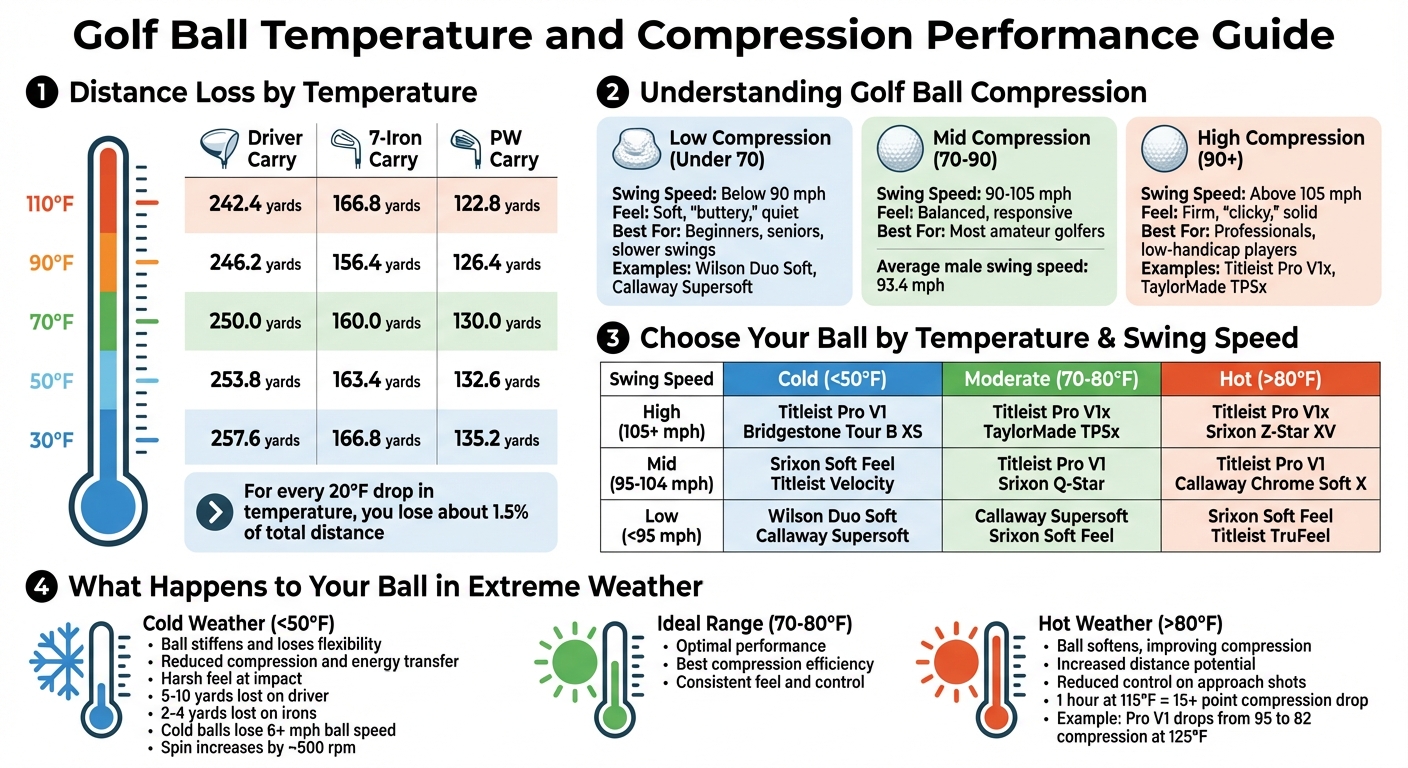
Golf Ball Temperature Performance Guide: Distance Loss and Compression by Weather
Cold Balls: Temperature vs. Compression
Understanding how environmental factors impact your equipment is a key step for those looking to shoot like the pros and lower their scores.
sbb-itb-bcd8bdd
What Is Golf Ball Compression?
Golf ball compression is all about how much the ball squishes when it hits the clubface. It’s a number that measures how much the ball deforms on impact. Imagine squeezing a racquetball versus a billiard ball. The racquetball gives way easily, while the billiard ball barely changes shape. That’s the difference between low and high compression.
The compression scale typically runs from 30 (super soft) to 120 (very firm). A ball rated at 40 will flatten noticeably on impact, while a 100-rated ball stays much firmer. The ball’s core acts like a spring, storing energy when compressed and releasing it as the ball rebounds off the clubface.
“Think of the core as the engine of the shot. At impact, it flattens, stores strain energy, and then rebounds into the dimpled airframe that carries it downrange.” – Snell Golf
There’s no universal standard for compression testing, though. For example, a “90” compression ball from Titleist might not match a “90” from Callaway because each brand uses its own testing methods. Instead of focusing solely on numbers, it’s better to see how a ball performs with your swing.
Understanding compression helps you choose a ball that aligns with your swing speed, which we’ll dive into next.
The Science Behind Compression
When your clubface strikes the ball, it causes a brief moment of squishing, or deformation. During this fraction of a second, the core compresses and stores energy. Once the ball leaves the clubface, that energy gets released – like a spring snapping back – propelling the ball forward. This efficiency is measured by something called the Coefficient of Restitution (COR).
Matching your swing speed to the right compression rating is critical. If your swing is too slow for a high-compression ball, the core won’t compress enough to generate energy, resulting in shorter shots. On the other hand, if your swing is too fast for a low-compression ball, it will over-compress, creating too much spin and reducing control.
“The ideal compression is all about matching the ball’s ‘engine’ to the ‘power’ of your swing. If they aren’t matched correctly, you’re leaving yards and consistency on the table.” – Spencer Lanoue, Caddie AI
Compression influences three key areas of performance: feel (how the ball feels at impact), distance (how well energy is transferred), and spin (how the ball interacts with the clubface). While the core determines compression behavior, the cover material – like urethane or ionomer – plays a big role in controlling spin and overall feel around the greens. Next, we’ll explore how compression impacts energy transfer during impact.
Low, Mid, and High Compression Balls
Low-compression balls (under 70) are designed for golfers with swing speeds below 90 mph. These balls squish easily, helping slower swings generate more ball speed. They feel soft and produce a quiet impact sound. This category is ideal for beginners, seniors, and many female golfers whose average driver swing speed is around 78 mph. For more ways to improve your game, check out our latest golf tips.
Mid-compression balls (70-90) are a great fit for most amateur golfers with swing speeds between 90 and 105 mph. The average male amateur swings at 93.4 mph, making this the most popular category. These balls strike a balance between distance and control, offering a responsive feel without being overly firm.
High-compression balls (90+) cater to fast swings over 105 mph. They resist excessive deformation at high speeds, preserving ball speed and producing a penetrating ball flight. These balls tend to feel firm or “clicky”, which many professionals and low-handicap players prefer.
| Compression Category | Rating Range | Recommended Swing Speed | Feel Characteristics |
|---|---|---|---|
| Low | Under 70 | Below 90 mph | Soft, “buttery”, quiet |
| Mid | 70-90 | 90-105 mph | Balanced, responsive |
| High | 90+ | Above 105 mph | Firm, “clicky”, solid |
If you don’t have access to a launch monitor, your total driver distance can give you a ballpark idea. Drives under 220 yards suggest a swing speed below 90 mph (low compression). Drives between 220 and 260 yards indicate a swing speed of 90-105 mph (mid compression). If you’re driving over 260 yards, you’re likely swinging faster than 105 mph (high compression).
How Temperature Affects Golf Ball Compression and Performance
Temperature has a direct impact on how a golf ball performs, influencing its material properties and how it interacts with the air. The core and cover materials, typically made of rubber composites and urethane or surlyn, respond to temperature changes, which affects the ball’s compression and overall flight. Additionally, temperature shifts alter air density, affecting drag and lift during the ball’s flight. These combined factors play a significant role in determining distance and control on the course.
The ideal temperature range for optimal golf ball performance is between 70°F and 80°F. Outside of this range, noticeable changes occur in how the ball behaves during play.
Effects of Cold Temperatures (Below 50°F)
When temperatures drop, golf balls become stiffer as the core and cover materials lose flexibility. This reduces their ability to compress and rebound effectively, which is essential for maximizing distance. On top of that, colder air is denser, increasing drag and lift. As a result, the ball may fly higher but travel shorter distances. For every 20°F temperature drop, golfers can expect to lose about 1.5% of their total distance. For example, a 10°C (18°F) decrease could reduce driver carry by 5–10 yards and iron shots by 2–4 yards.
Cold golf balls also produce slower ball speeds, lower launch angles, and higher spin rates. In testing, cold balls lost over 6 mph in ball speed, spun nearly 500 rpm more, and traveled 21 fewer yards compared to balls at room temperature.
The feel of the ball changes dramatically in the cold. Many golfers describe the impact as harsh, with a sharp, unpleasant sound. One tester likened it to “miniature car accidents”. Scratch golfer Hank Vereschzagin commented that hitting sub-zero balls felt like “the club face was stopping on impact”, indicating significant energy loss due to reduced compression.

| Temperature (°F) | Driver Carry (Yards) | 7-Iron Carry (Yards) | PW Carry (Yards) |
|---|---|---|---|
| 30° | 242.4 | 152.8 | 122.8 |
| 50° | 246.2 | 156.4 | 126.4 |
| 70° | 250.0 | 160.0 | 130.0 |
| 90° | 253.8 | 163.4 | 132.6 |
| 110° | 257.6 | 166.8 | 135.2 |
Data from Andrew Rice’s TrackMan study
Effects of Hot Temperatures (Above 80°F)
Warm weather, on the other hand, tends to enhance distance. In less dense air, the ball encounters less resistance, allowing it to travel farther. Heat also softens the ball’s materials, improving compression efficiency and energy transfer from the clubface.
However, extreme heat can have drawbacks. Tests by MyGolfSpy revealed that exposing a golf ball to 115°F for just one hour can significantly reduce its compression by over 15 points. For example, a Titleist Pro V1 with a compression rating of 95 at 70°F dropped to 82 compression when heated to 125°F, effectively transforming a high-compression ball into a mid-compression one.
While hot weather can boost distance, the softer ball may reduce control, particularly on approach shots where excessive spin can become an issue. Gene Parente, co-host of Fully Equipped, cautions that “below 55 degrees is when you start to see degradation… The core gets cold and it takes an hour for it to warm up”. Conversely, a ball left in a car trunk at over 100°F may behave unpredictably until it cools down.
The key to consistent performance lies in balancing compression efficiency and control. Temperatures between 70°F and 90°F provide the best conditions, offering improved compression without the drawbacks of extreme heat. Being mindful of how temperature affects your golf ball can help you improve your golf game by adapting to varying conditions.
Golf Ball Recommendations by Temperature and Swing Speed
Temperature plays a big role in how golf balls perform, and selecting the right ball for your swing speed and weather conditions can make a noticeable difference. Here’s a breakdown of how to match your swing speed to ball compression and adjust for temperature changes.
- Swing speed under 85 mph: Go for 30–60 compression.
- Swing speed between 85–105 mph: Opt for 60–90 compression.
- Swing speed over 105 mph: Use 90+ compression.
However, these guidelines shift as temperatures rise or fall.
Cold Weather Adjustments (<50°F)
When the mercury dips below 50°F, golf balls stiffen, reducing their responsiveness. To counter this, choose a ball with lower compression than usual. For example:
- High-speed swingers (105+ mph): Swap your usual high-compression balls, like the Titleist Pro V1x, for mid-compression options such as the Titleist Pro V1 or Bridgestone Tour B XS.
- Mid-speed players (95–104 mph): Opt for low-compression balls like the Srixon Soft Feel or Titleist Velocity.
- Slower swingers (<95 mph): Stick with ultra-soft balls like the Wilson Duo Soft or Callaway Supersoft.
Mark, an experienced golfer, shares his approach:
“When the temps are around 40 degrees, I use Wilson Duo Soft balls. Lower compression, softer feel than firmer golf balls in cooler/cold temperatures”.
This strategy ensures the ball remains responsive despite the cold.
Hot Weather Adjustments (>80°F)
In hot conditions, golf balls soften, which can lead to a loss of control. To maintain performance, go for firmer options:
- High-speed swingers (105+ mph): Stick with high-compression balls like the Titleist Pro V1x or TaylorMade TP5x.
- Mid-speed players (95–104 mph): Use mid-high compression balls like the Titleist Pro V1 or Callaway Chrome Soft X.
- Slower swingers (<95 mph): Balance distance and control with low-mid compression balls like the Srixon Soft Feel or Titleist TruFeel.
Comparing Golf Ball Options for Different Conditions
| Swing Speed | Cold Weather (<50°F) | Moderate Weather (70–80°F) | Hot Weather (>80°F) |
|---|---|---|---|
| High (105+ mph) | Titleist Pro V1, Bridgestone Tour B XS | Titleist Pro V1x, TaylorMade TP5x | Titleist Pro V1x, Srixon Z-Star XV |
| Mid (95–104 mph) | Srixon Soft Feel, Titleist Velocity | Titleist Pro V1, Srixon Q-Star | Titleist Pro V1, Callaway Chrome Soft X |
| Low (<95 mph) | Wilson Duo Soft, Callaway Supersoft | Callaway Supersoft, Srixon Soft Feel | Srixon Soft Feel, Titleist TruFeel |
For cold weather, aim for balls with 10–20 points lower compression than your usual choice. In hot weather, stick to equal or higher compression to keep your game consistent .
Tips for Choosing the Right Ball in Variable Weather
Temperature plays a big role in how a ball compresses and performs, so adjusting your approach both during and between rounds can make a noticeable difference. Weather can change quickly during a round, and having a plan to adapt ensures you maintain consistency from the first tee to the final putt.
Adapting to Weather Changes Mid-Round
One of the easiest ways to deal with cold weather is to rotate between two balls during your round. Play one ball while keeping the other in your pocket, then switch after each hole. Barry Lotz of PGTAA suggests this method to keep both balls slightly warm and performing closer to their best – without breaking any rules.
This approach prevents the ball’s core from stiffening, which helps maintain both distance and feel. Dean Snell, Founder of Snell Golf, explains that “a ball properly stored will take several hours to become cold and stiffen”. By keeping a ball warm, you can extend its responsiveness over multiple holes. And if temperatures take an unexpected dip mid-round, switching to a lower compression ball from your bag can help you regain some of the lost distance.
While mid-round strategies are helpful, how you store your balls off the course is just as important for consistent performance.
Storage Tips for Maintaining Ball Performance
Avoid leaving balls in your car trunk, where temperatures can swing wildly – from below freezing in winter to over 150°F in summer. Gene Parente, Co-host of the Fully Equipped Podcast, advises:
“Below 55 degrees is when you start to see degradation… If it gets cold, don’t keep your golf balls in the trunk or golf bag. Bring them inside”.
For the best results, store your golf balls indoors at room temperature – in your home or office, not in an unheated garage. Heat can be especially harmful: just one hour at 115°F can reduce a ball’s compression by over 15 points. If your balls have been sitting in the cold, bring them inside at least 12–24 hours before your round so the core has time to reach a playable temperature . This simple habit helps protect your equipment and ensures your balls perform consistently when it matters most.
Conclusion
Temperature has a noticeable impact on golf ball compression and performance. Cold air not only increases drag but also stiffens the ball’s core and cover, creating a double-whammy that reduces distance significantly. Research shows that even an 18°F drop can lead to a measurable loss in distance. On the flip side, heat can alter a ball’s compression even faster – just one hour at 115°F can lower compression by over 15 points.
The takeaway? Picking the right golf ball for the weather matters. Aligning your ball’s compression with both your swing speed and the temperature can help you maintain steady distance, feel, and trajectory. For instance, in chilly conditions below 50°F, a lower-compression ball can counteract the stiffening effect, while in warmer weather, players with faster swings might find higher-compression balls more effective.

FAQs
Should I change golf balls when the temperature drops or rises?
You don’t have to swap out your golf balls just because the temperature drops or rises. That said, keeping them stored at room temperature is key to maintaining their performance. In colder weather, warming them up a bit can help retain their compression and ensure you don’t lose any distance on your shots.
How can I estimate my swing speed without a launch monitor?
You can get a rough idea of your swing speed by matching your usual shot distances with established swing speed ranges. For instance, if your drives average about 200 yards, your swing speed is likely between 90 and 100 mph. You can also use charts or online calculators to estimate your speed based on your average driving distance. While these methods aren’t as accurate as using a launch monitor, they can still give you a fairly good approximation.
How do I keep golf balls warm during a cold round (legally)?
To keep your golf balls warm during a chilly round – without breaking any rules – you can rotate them between holes by keeping one in your pocket. This simple trick helps the ball warm up a bit before you use it, improving its performance in cold weather.

Leave a Reply